I. Executive Summary: The Resilience–Uncertainty Equilibrium
A. Overview of the Macro Landscape
The global economic environment entering the fourth quarter of 2025 is characterized by a challenging juxtaposition, best described as "tenuous resilience amid persistent uncertainty." Despite elevated geopolitical risks, lingering inflation concerns, and significant structural pressures, the baseline forecast remains generally positive. Global growth projections have stabilized, projected to hover between $3.1\%$ and $3.3\%$ through 2026, suggesting the long-anticipated severe recession has been averted, at least in the near term.This unexpected resilience is supported by several crucial pillars that underpin current market stability:
1. Financial conditions remain supportive, enabling continued capital allocation and growth. 2. Household and corporate balance sheets across developed economies remain robust, providing a buffer against unexpected cyclical shocks. 3. Energy prices have remained relatively low, mitigating a significant inflationary pressure point seen in prior years. 4. The structural promise of an AI-driven productivity boost provides a forward-looking anchor for equity valuations and long-term economic acceleration.
The prevailing sentiment among large institutional investors is to remain "pro-risk" heading into Q4, but this stance requires being "active and vigilant." The conflicting forces—monetary easing versus fiscal instability, and productivity gains versus energy constraints—demand a highly selective and defensively hedged approach to portfolio construction.
B. Core Themes Shaping Investment in Q4 2025
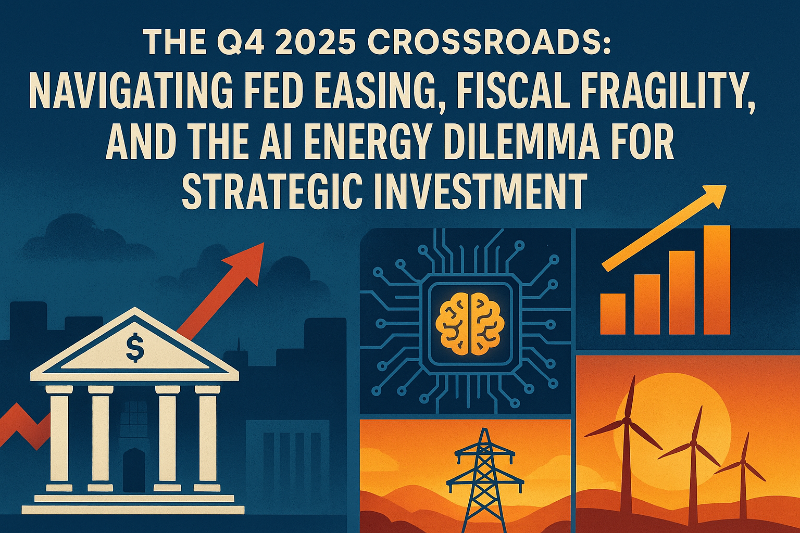
Four intersecting macro themes define the investment landscape:- Monetary Policy Pivot: Central banks, especially the Fed, have moved from aggressive inflation-fighting to "risk management" easing—aiming for rate cuts while avoiding recession. This pivot supports risk assets near-term. - Fiscal–Monetary Friction: Widespread loose fiscal policy is changing fixed income dynamics and keeping long-term yields elevated—representing a structural risk to traditional asset allocation. - Geoeconomic Fragmentation: National-security driven rewiring of globalization continues; while generalized trade uncertainty may have peaked, local economic impacts (e.g., Southeast Asia slowdown) remain acute. - Technological Collision: Generative AI’s productivity promise is colliding with energy constraints—AI’s soaring energy intensity forces companies to re-evaluate net-zero plans.
C. Summary of Key Tactical Asset Allocation Calls
Strategic conclusions mandate rotation toward technological-scale beneficiaries while emphasizing duration management and resilient hedges:- Equities: Overweight U.S. (AI concentration) and Japan (corporate reform, inflation). - Fixed Income: Favor duration shortening and credit risk — overweight short-duration Treasuries and high yield. - Alternatives: Overweight commodities as inflation/geopolitical hedges.
---
II. Global Macroeconomic Diagnosis: Policy Divergence and Fiscal Fragility
A. Central Bank Policy: Navigating the Soft Landing
The Fed’s Insurance Cut and Forward Guidance
The Federal Reserve initiated easing with a 25 bps cut at the September meeting, bringing the funds rate to the $4.0\%$–$4.25\%$ range. This was the first cut in nine months and followed softer-than-expected labor data. The cut is best interpreted as a “risk management” action—precautionary, not a full commitment to a long easing cycle. Near-term further cuts depend critically on labor market momentum.The Perfection Pricing Dilemma in US Equities
Markets have priced a near-perfect soft-landing: rate cuts that reduce policy tightness enough to support growth but not enough to trigger recession. This "perfection pricing" supports premium US equity valuations, but they remain vulnerable to two adverse outcomes:1. A continued strong labor market that halts further cuts (Fed pause). 2. Inflation reacceleration (from tariffs or fiscal looseness) forcing a policy reversal.
Either scenario risks a sharp valuation correction.
The ECB’s Data-Dependent Caution
The ECB remains cautious and data-dependent. Transmission of easing is uneven: corporate borrowing costs are easing faster than household relief. With headline inflation around $2.1\%$–$2.2\%$ YoY in October, the ECB’s pace contrasts with more aggressive US easing expectations.B. Inflation Dynamics and the Tariff Uplift
Global headline inflation is moderating and is expected to fall to $4.4\%$ in 2025. However, the U.S. is a "sticky spot"—services inflation remains elevated and keeps inflation above target. Tariff-induced import cost increases and loose fiscal policy raise the risk of reaccelerating inflation.Implication: If nominal rates fall while inflation remains elevated, real yields compress, reducing the real return on cash and nominal bonds. Hedging via TIPS and commodities (especially gold) becomes essential.
C. Fiscal Deterioration: The Erosion of Macro Anchors
Elevated debt loads and loose fiscal policy are pushing fiscal concerns to the fore. Long-term bond yields have risen to multi-decade highs in several developed markets, signaling investor demand for higher compensation for sovereign risk.Fixed income strategy redefinition: The dominant sovereign risk has shifted from cyclical to systemic (solvency/fiscal decay). Thus, favor short U.S. Treasuries tactically and avoid long-duration sovereign exposure as a default safe haven.
---
III. Structural Forces Reshaping the Global Economy
A. The Generative AI Productivity Shock
Generative AI is a major secular growth driver. Estimates suggest AI could add 0.5 to 3.4 percentage points annually to labor productivity through 2040. This supports US corporate earnings and justifies overweight positions in AI-rich equities.Concentration risk: Gains are concentrated in a few large tech firms ("Magnificent 7"); future alpha requires diffusion—owning companies that deploy AI to improve operations across traditional industries.
B. The AI vs. Net-Zero Conflict: Energy as the Limiting Factor
AI is energy-intensive. Training large models and running inference at scale significantly raises electricity demand and Scope 2 emissions—forcing tension with corporate net-zero targets.Consequences and investment angle:
- Energy is a core constraint—data centers and AI compute create a structural demand shock. - ESG backlash: Companies lean on offsets, but offsets don’t eliminate underlying fossil-fuel dependence. - Utility sector opportunity: Utilities, grid builders, and energy-infrastructure firms convert from defensive to growth exposures. Investments in grid upgrades, renewables manufacturing, next-gen power (including nuclear), and energy-efficiency software are key.
---
IV. Geopolitical Fragmentation and Trade Rewiring
A. Geoeconomic Confrontation and Policy Risk
Geopolitical volatility is high—state-based armed conflict and geoeconomic confrontation are top systemic risks. While generalized trade uncertainty may have peaked (roughly 60% of U.S. imports covered by deals), the push toward resilience (reshoring, regional supply chains, defense and infrastructure spending) persists.Capital allocation shift: Move from generic tariff hedges to resilience investments—reshoring, domestic manufacturing, defense and infrastructure plays.
B. Regional Vulnerability and Trade Toll
Trade and tariff effects are localized: Southeast Asia and some small open economies are most exposed to near-term slowdowns. For EM fixed income, prefer Hard Currency EM debt over local-currency exposure to mitigate currency and local growth risks.---
V. Strategic Asset Allocation for Q4 2025 and 2026
A. Equity Strategy: Focus on Quality and Relative Value
1. United States — Overweight Driven by AI concentration, superior profitability, and Fed easing expectations. Elevated valuations require earnings follow-through.2. Japan — Overweight Benefits from returning inflation, corporate reform, and shareholder-friendly policies. Tactical preference for unhedged exposure given JPY defensive tendencies.
3. Non-US Developed & EM — Neutral/Selective Better relative valuations vs. U.S.; potential tailwind from a weaker USD. Neutral overall due to geopolitical and growth risks.
Valuation Summary (qualitative): US P/Es well above long-run averages; non-US nearer averages—favor international diversification.
B. Fixed Income Strategy: Income and Duration Skew
1. Duration Management: Overweight Short U.S. Treasuries; Neutral on long Treasuries. 2. Credit Strategy: Overweight High Yield (prefer IG < HY given pro-risk scenario). Overweight EM Debt (Hard Currency) to access yield while avoiding FX risk.C. Alternatives & Portfolio Hedges
- Commodities — Overweight: Inflation hedge and geopolitical risk premium on energy/commodities. - Gold: Acts as geopolitical hedge and store of value; priced higher in Q3 2025 after USD weakness. - Infrastructure / Utilities / Energy-infra: Beneficiaries of AI energy demand and reshoring.---
VI. Conclusion and Forward-Looking Risk Monitor
The global economy sits at a crossroads: near-term soft-landing optimism (AI + Fed easing) versus long-term fiscal and geopolitical deterioration. Successful investing requires pursuing secular AI gains in equities (U.S., Japan) while rigorously hedging duration and fiscal risks (short duration, commodities, gold).Key Risks Requiring Vigilance
| Risk Factor | Likelihood / Severity | Investment Implication | |---|---:|---| | Labor Market Rebound | High (potential for Fed pause) | An unexpected labor market rebound halts cuts → sharp valuation correction for premium US equities | | Fiscal Policy Shock | High (structural pressure) | Elevated debt focus causes spike in long-term yields → traditional fixed income impaired | | Geoeconomic Escalation | High (top 3 risk) | Conflict increases commodity/energy risk premia; disrupts trade flows | | AI Energy Crisis | Medium–High (structural) | Rising energy costs undermine net-zero plans; capital shifts to utilities/infrastructure |---
References & Source Notes
> (Source identifiers referenced inline in the full draft were retained for attribution and internal cross-checks.)---
Appendix (Tactical Checklist)
- Overweight: US equities (select AI winners), Japan equities, commodities, high-yield credit, EM hard-currency debt. - Neutral: Non-US developed & EM equities (selective). - Underweight / Caution: Long-duration sovereigns, local-currency EM debt without hedging. - Hedges: TIPS, gold, short-duration Treasuries, energy/infrastructure equities.---
Prepared as a strategic macro-investment brief for Q4 2025 positioning and risk monitoring.