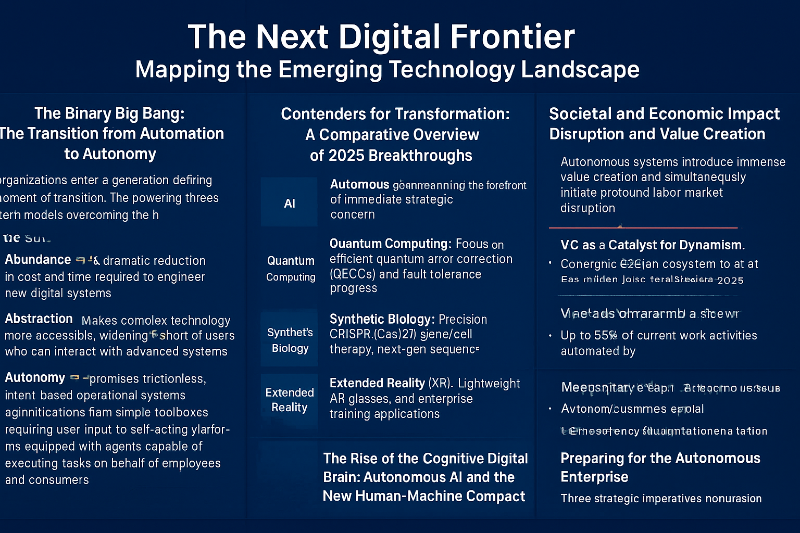
I. The Next Digital Frontier: Mapping the Emerging Technology Landscape
The trajectory of technological innovation is rarely linear; rather, it proceeds through generational leaps driven by foundational shifts in capability. The current period, spanning 2025 and beyond, represents such an inflection point, pushing enterprise technology past mere automation and into true autonomy. This report identifies Autonomous Generative AI—the concept known as the Cognitive Digital Brain—as the singular, most impactful emerging technology poised to fundamentally restructure society and global business in the immediate future.
---
The Binary Big Bang: The Transition from Automation to Autonomy
Organizations across the globe are entering what has been described as a generation-defining moment of transition. This shift was catalyzed when foundational models successfully overcame the natural language barrier, transforming how core technology systems are designed, operated, and utilized. This revolutionary speed is pushing the very limits of software engineering, leading to an unprecedented acceleration of digital output and innovation across all sectors.
The technological transition is characterized by three reinforcing pillars: Abundance, Abstraction, and Autonomy.
- Abundance: Dramatic reduction in cost and time required to engineer new digital systems. - Abstraction: Makes complex technology more accessible, widening the cohort of users who can interact with advanced systems. - Autonomy: Promises frictionless, intent-based operational systems.
This signifies a fundamental redefinition of enterprise technology, moving applications from being simple toolboxes requiring user input to self-acting platforms equipped with agents capable of executing tasks on behalf of employees and consumers.
---
Contenders for Transformation: A Comparative Overview of 2025 Breakthroughs
While Autonomous AI commands the forefront of immediate strategic concern, it is essential to contextualize its rise against other transformative fields that are simultaneously achieving critical breakthroughs.
Quantum Computing: The Fault Tolerance Threshold
Quantum computing continues to advance rapidly, focusing heavily on resolving foundational engineering hurdles. The pathway to achieving quantum advantage—where quantum computers outperform classical counterparts—is predicated on developing more efficient Quantum Error Correction Codes (QECCs) and scaling up qubit capacity.
Researchers at IBM reported a breakthrough in advanced error correction by running their decoder algorithm on AMD FPGA chips—ten times faster than required to keep pace with their quantum computer. This progress may accelerate IBM’s large-scale Starling Quantum Computer (targeted for 2029), hinting that near-term advantage will emerge through hybrid classical-quantum systems.
---
Synthetic Biology and Gene Editing: The Delivery Bottleneck
The synthetic biology sector is surging, driven by CRISPR-Cas9 gene editing, automated DNA synthesis, and cellular agriculture. The global gene editing market is projected to reach $40.10 billion by 2034, growing at a CAGR of 15.73%.
Recent innovation centers on delivery, not precision. Caszyme’s discovery of the Cas12l nuclease family—compact at ~850 amino acids—enables more efficient delivery via viral vectors, solving a key bottleneck for gene/cell therapy scalability.
---
Extended Reality (XR) and Spatial Computing
The XR ecosystem (AR, VR, MR) is expanding rapidly. The global AR/VR market will grow from $20.43B in 2025 to $85.56B by 2030 (CAGR 33.16%). Enterprise training leads adoption, projected at $22.56B in 2025, but impact remains application-specific (training, gaming, remote assistance).
---
The Critical Choice: Justifying Autonomous AI’s Immediate Primacy
Autonomous AI dominates due to its convergence across five critical vectors:
1. Hardware efficiency 2. Unprecedented enterprise integration 3. Validated reliability in high-stakes fields 4. Imminent economic disruption 5. Complex regulatory implications
No other technology cluster exhibits such breadth of cross-sector impact within 2025–2030.
---
Table 1: Emerging Technology Market Momentum (2025 Projections)
| Technology Cluster | Primary Breakthroughs (2025 Focus) | Market Growth Stage | Immediate Cross-Sector Readiness | |--------------------|------------------------------------|--------------------|----------------------------------| | Autonomous/Generative AI | Cognitive Digital Brain, Self-Fact-Checking LLMs, Neuromorphic Chips | Exponential (Binary Big Bang) | High (Enterprise, Healthcare, Finance, Labor) | | Quantum Computing | Efficient QECCs, Fault Tolerance Progress | Nascent Stage, High R&D Investment | Medium-Low (Security, Drug Discovery, Supply Chain Optimization) | | Synthetic Biology | Cas12l Nuclease, Gene/Cell Therapy | High (15.73% CAGR to 2034) | Medium (Healthcare, Agriculture, Biomanufacturing) | | Extended Reality (XR) | Lightweight AR Glasses, Enterprise Training | High (33.16% CAGR to 2030) | Medium (Training, Gaming, Defense, Retail) |
---
II. The Rise of the Cognitive Digital Brain: Autonomous AI and the New Human-Machine Compact
The Cognitive Digital Brain represents the operational implementation of Autonomy. It evolves AI from generation to intent-based autonomous action, capable of executing tasks independently across enterprises.
---
Defining True Autonomy: The Cognitive Digital Brain
Executives must synthesize all AI components into a cohesive Cognitive Digital Brain, embedding institutional knowledge, value chains, and workflows. This transforms software into proactive agents that fulfill human objectives rather than wait for commands.
---
The Engines of Reliability: Factuality, Context, and Multimodal Intelligence
Autonomous systems in critical sectors demand near-perfect reliability. Next-gen LLMs integrate self-fact-checking mechanisms—cross-validating outputs against authoritative sources.
- Baseline model accuracy: 0.856 - Self-RAG (SRAG) accuracy: 0.973 (on health claim dataset)
Such results turn LLMs into trusted decision-making collaborators.
Further advancements include: - Improved contextual comprehension through advanced attention mechanisms. - Multimodal capabilities (text, vision, audio) enabling dynamic content generation.
---
Hardware Enablement: The Sustainability Mandate
AI’s computational explosion has driven a hardware renaissance:
- Neuromorphic chips (brain-inspired) offer up to 500× lower energy use and 100× latency reduction. - Essential for edge autonomy in IoT, robotics, and real-time AI.
Meanwhile, Green Data Centers are projected to reach $509.6B by 2030 (CAGR 19.4%)—highlighting sustainability as a structural requirement for AI scaling.
---
Business Transformation: Redefining Workflows and Value Chains
To deploy Cognitive Digital Brains effectively, organizations must:
- Establish transparent governance and explainable decision pathways. - Embed traceable feedback loops for alignment and accountability. - Build employee trust through explainable system design.
---
III. Societal and Economic Impact: Disruption and Value Creation
Autonomous AI drives both productivity gains and labor displacement.
---
The Great Labor Reckoning: Automation’s Immediate Impact
- 85 million jobs replaced globally by 2025 - Up to 55% of work activities automated by 2035 - 14% of employees to change careers by 2030 - High-risk group: educated white-collar workers earning ≤ $80k
Table 2: Projected Workforce Disruption and Automation Risks
| Metric / Timeframe | Impact Projection | Affected Sector | Notes | |--------------------|------------------|-----------------|-------| | Jobs Replaced by 2025 | ~85 Million | Retail, Manufacturing, Clerical | Major early displacement | | Workforce Activities Automated by 2035 | Up to 55% | Cross-sector | White-collar most affected | | Required Career Changes by 2030 | 14% Global Employees | All | Driven by AI, robotics, digitization | | High-Risk Demographic | White-collar ≤ $80k | Admin, Clerical, Info Processing | Short-term exposure |
---
VC as a Catalyst for Dynamism
VC funding accelerates the cycle of creative destruction:
- Startups reaching VC due diligence grow 30% faster on average. - Autonomous AI and hyper-efficient capital allocation amplify market churn and innovation velocity. - Policymakers must adapt labor laws and safety nets rapidly to keep pace.
---
IV. The Evolving Governance Landscape: Trust and Transparency in the Autonomous Age
Autonomy introduces deep ethical and accountability challenges.
---
Fragmented Regulation, Converging Principles
- Global AI regulation remains fragmented. - EU offers comprehensive frameworks; African nations (Mauritius, Kenya, Nigeria) actively developing strategies. - Convergence around Asilomar and Montréal Declarations—emphasizing accountability, justice, well-being, autonomy, and democracy.
Examples of local, reactive laws: - North Dakota: banned AI-powered stalking robots. - Oregon: barred AI from using human professional titles.
Enterprises must adopt global ethical standards proactively to mitigate fragmented policy risk.
---
The Accountability Gap in Autonomous Systems
Even “weak AI” creates non-trivial risks (e.g., infrastructure malfunction). Determining liability for autonomous agent errors is a critical policy challenge.
The neurotechnology boom (700% investment surge) provides regulatory precedent, as brain-computer interfaces blur lines between human and machine agency.
---
V. Conclusion: Preparing for the Autonomous Enterprise
The Cognitive Digital Brain heralds the Age of Autonomy, demanding new strategic imperatives:
1. Mandate AI Reliability
Adopt self-fact-checking LLMs (SRAG, CRAG) as baseline standards for enterprise AI. Reliability → Trust → Investment.2. Ensure Sustainable Scaling
Pair neuromorphic edge computing with green data infrastructure to manage exponential growth sustainably.3. Establish a Proactive Trust Compact
Implement explainable AI governance, traceable monitoring, and global ethical compliance to preempt fragmented regulations.---
Final Note
The biggest challenge is not technological—it’s institutional adaptation. To harness autonomy responsibly, enterprises and governments must rapidly scale governance, infrastructure, and expertise. A critical talent deficit in AI, quantum computing, and synthetic biology underscores the urgency of building human capacity to govern what has already begun to act independently.