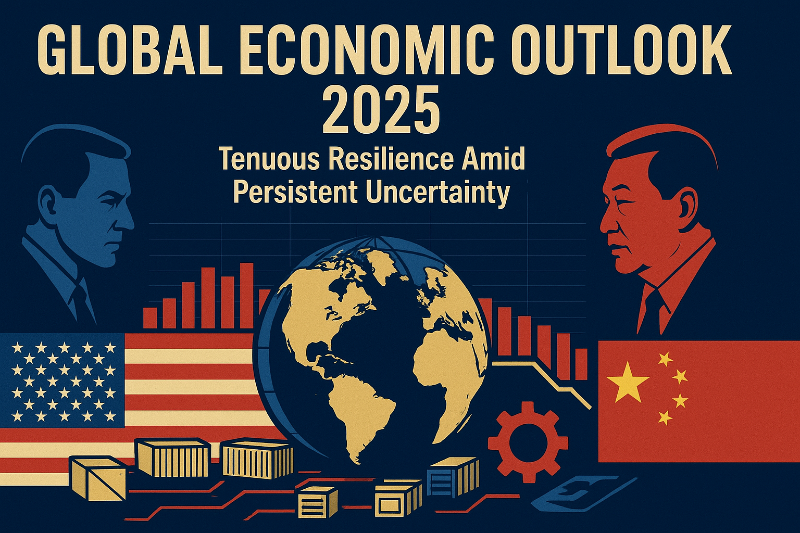
Global Economic Outlook 2025: Tenuous Resilience Amid Persistent Uncertainty
Section I: The Critical Pivot — Geopolitical Escalation and Supply Chain Weaponization
1.1 The October 2025 Escalation: A Geoeconomic Confrontation
The October 2025 escalation between the United States and China marks a definitive shift from managed competition to overt economic conflict. On October 9, China’s Ministry of Commerce (MOFCOM) expanded export restrictions on rare earths, production equipment, and processing technologies, weaponizing its dominant supply chain position. The move was framed as retaliation against Washington’s September 2025 chipmaking export controls.In response, the U.S. administration under President Donald Trump announced on October 10 a proposed 100% tariff on all Chinese imports, effective November 1. This measure—"over and above any Tariff that they are currently paying"—would lift the average U.S. tariff rate on Chinese goods to 57.6%, with effective rates for some goods nearing 150%.
1.2 China’s Weaponization of Critical Minerals and FDPR Equivalent
China’s geopolitical leverage lies in its dominance of the rare earth supply chain, controlling: - 70% of global mining - 90% of processing - 93% of permanent magnet manufacturingKey Objectives: - Target Western defense industries: From December 1, 2025, China will restrict exports of rare earths and technology for military use. This directly impacts the U.S. defense industrial base, including production of F-35s, submarines, and guided munitions. - Apply FDPR-like extraterritorial controls: Any product containing over 0.1% Chinese-origin heavy rare earths or processed using Chinese technology requires Beijing’s approval for export.
This policy forces global manufacturers, especially in Europe and Japan, into an impossible compliance environment—risking sanctions if components enter U.S. defense supply chains.
| Actor | Action (Oct 2025) | Targeted Sector/Material | Impact/Leverage | |------------|----------------------|-----------------------------|---------------------| | China (MOFCOM) | Expanded Export Restrictions/Licensing | Rare Earths, Magnets, Tech | Disrupts US defense/EV chains; applies FDPR-style control | | US (Trump Admin) | Proposed 100% Tariff (Effective Nov 1) | All Chinese Imports | Massive inflationary shock; escalates trade war | | US (DoD/Dept. of War) | $400M Equity Investment, 10-Year Offtake Agreement | Domestic Rare Earth Processing | Stabilizes supply via price floor; mitigates defense vulnerability |
---
Section II: Global Macroeconomic Fragmentation and Divergence
2.1 Global Outlook: Resilience Tested by Policy Risk
Global growth remains around 3.0–3.2%, characterized by "tenuous resilience". However, policy uncertainty and escalating trade restrictions are cited as the top disruption risks. The World Bank projects weaker growth at 2.3% for 2025, emphasizing the cost of fragmentation.2.2 The US Growth Anomaly and Stagflationary Headwinds
Despite robust growth (3.9% GDPNow Q3 2025), U.S. protectionist measures create stagflationary pressures: - Average tariff rate: 18% (highest since 1934) - Headline CPI forecast (Q4 2025): 3.0% - Average household income loss: ~$1,800 in 2025The Federal Reserve faces a policy dilemma—rate cuts risk worsening inflation, while rate hikes may suppress growth, locking the U.S. into a security vs. consumer welfare trade-off.
2.3 China’s Export Reliance and Internal Weakness
China’s 4.8% YoY growth (Q3 2025) masks deep structural fragility: - Domestic demand remains weak (CPI: 0.2% in 2024) - Exports to the U.S. fell 27% in September 2025 - Manufacturing overcapacity may force deflationary export pressures| Indicator | Global (IMF/WB) | United States | China | |----------------|---------------------|------------------|-----------| | Real GDP Growth (2025E) | 3.0–3.2% | 3.0%+ | 4.8% (export-driven) | | Headline Inflation (Q4 2025E) | 4.2% | 3.0% | 0.2% | | Effective Tariff Rate | N/A | 18% | N/A |
---
Section III: Financial Market Transmission and Stability Check
3.1 Equity Market Resilience and Policy Disconnect
Equity markets remain buoyant: - MSCI World YTD: +17.83% - Hang Seng: +31.9%Yet, this optimism diverges from geopolitical risk indicators. Institutions are pivoting toward large-cap, defensive stocks, signaling caution despite surface-level market strength.
3.2 Sovereign Debt Divergence and Capital Flow Risks
Yield spreads highlight policy divergence: - US 10Y Treasury: 4.01% - German Bund: 2.58% - JGB: 1.63%The IMF warns that geopolitical fragmentation exacerbates financial instability and limits global risk diversification.
3.3 Commodity Market Resilience
Despite geopolitical tensions: - Brent crude: $57.36 (Oct 20, 2025) - Forecast: $62/bbl (Q4 2025) → $52/bbl (H1 2026)Rising non-OPEC+ supply and falling industrial demand outweigh conflict-related premiums. Policy fragmentation is suppressing long-term commodity demand.
---
Section IV: The Supply Chain Conundrum — Industry-Specific Ripples
4.1 Automotive and EV Sector
China’s export controls have disrupted EV and magnet supply chains, causing plant shutdowns in Europe. EU Response: - Countervailing BEV duties (7.8–35.3%) - Promotion of magnet-free motor R&D (EESM)OEMs like BMW and Renault now prioritize technological independence over cost optimization.
4.2 Defense and Strategic Technology Base
The U.S. Department of War has adopted subsidized resilience: - $400M equity + $150M loan to MP Materials - 10-year price floor ($110/kg) for NdPr - 10-year offtake agreement covering 100% of domestic outputThis marks the institutionalization of security-over-efficiency economics, where strategic inputs are protected from global price competition.
4.3 Fragility of “China + 1” and Nearshoring
The "China + 1" model faces collapse: - Vietnam tariffs: Raised to 20% (from 3.3%) - Mexico: Facing 25–30% tariff risk on non-USMCA goods - EU: Facing 15% baseline U.S. tariffDiversification now requires deep, capital-intensive regional integration rather than surface-level relocation.
| Hub | FDI Trend | New Tariff Status | Strategic Implication | |----------|----------------|----------------------|---------------------------| | ASEAN | Rising FDI | 20% U.S. tariffs (Vietnam) | Compliance over cost advantage | | Mexico | Increasing imports | 25–30% tariff risk | Higher compliance costs | | EU | “De-risking” strategy | 15% U.S. baseline tariffs | Magnet-free EV R&D, domestic job preservation |
---
Section V: Navigating Decoupling — Strategic Policy Recommendations
5.1 Structural Deglobalization
Globalization has entered a managed retreat phase. National security imperatives now justify lower efficiency and slower growth. The global economy is fragmenting into regionalized blocs with state-backed industrial policy.5.2 Policy Prescriptions for Governments and IGOs
- Restore predictability: Transparent trade frameworks - Rebuild fiscal buffers: Medium-term frameworks to absorb shocks - Refocus IGOs: Avoid mission creep; prioritize macro-financial stability - Adopt EU “de-risking” model: Strategic competition without total decoupling5.3 Corporate Strategic Imperatives
1. From Just-in-Time to Just-in-Case: - Build redundancy, buffers, and supplier diversity. 2. Advanced Supply Chain Visibility: - Deploy AI and blockchain for multi-tier compliance and traceability. 3. Integrate Cyber-Geopolitics: - Treat supply chains as potential cyber targets. 4. Reallocate Capital for Autonomy: - Invest in regional R&D to bypass politically sensitive inputs.---
Conclusions
The October 2025 U.S.–China confrontation represents a structural fracture in the global economic system.
Three strategic conclusions: 1. The U.S. adopts a high-cost security strategy: Tariffs impose stagflationary taxes, constraining monetary flexibility. 2. Extraterritorial coercion becomes the norm: FDPR-style controls and tariff traps end simple “China + 1” strategies. 3. Permanent cost acceptance for supply security: Price floors and tech pivots signal a new era of strategic redundancy.
The global economy is transitioning from a single, hyper-efficient system to regionalized, state-subsidized blocs, where security of supply overrides efficiency as the new cornerstone of globalization.