The S&P 500 just brushed against another all-time high, with Q3 2025 GDP growth estimates clocking in at a surprisingly robust 3.9% annualized rate. At the same time, the Federal Reserve has finally, cautiously, begun its easing cycle, cutting its benchmark rate for the first time in September to the 4.0%-4.25% range.
On the surface, this looks like the “soft landing” we all dreamed of. Inflation is down, a recession was avoided, and the Fed is signaling victory.
But this rosy picture hides a fractured and unsettling global reality. Why does the U.S. economy feel like it’s in a different universe than the rest of the world? Is the inflation dragon truly slain, or just sleeping? And how much of America’s success is a genuine productivity boom versus a concentrated, AI-fueled bubble?
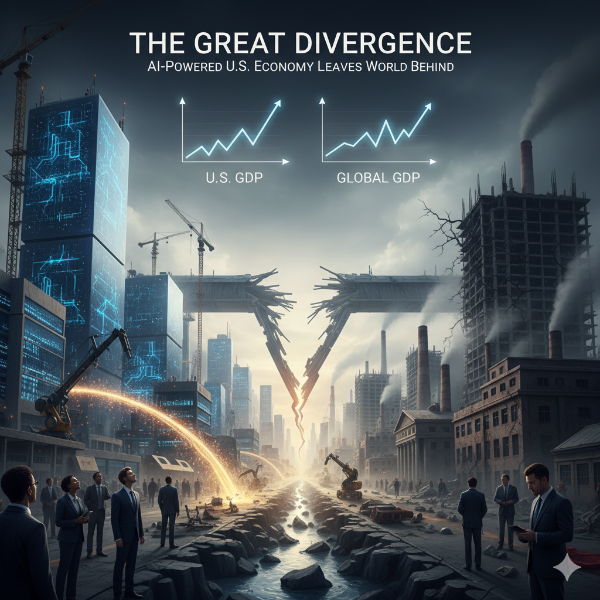
The global economy is no longer rising and falling in unison. We have entered a new era defined by a Great Divergence. To understand the volatility and opportunity ahead in 2026, we must analyze the three powerful, conflicting forces shaping our world:
1. The cautious pivot of central banks 2. The stark divergence of the world’s three largest economies 3. The explosive (and narrow) impact of the AI revolution
---
The “Sticky Pivot”: The Fed’s Cautious First Cut
The biggest story of late 2025 is the long-awaited pivot from the Federal Reserve. After a grueling hiking cycle, the Fed finally cut rates by 25 basis points. But this was not the “mission accomplished” party many had hoped for.
Fed Chair Jerome Powell was careful to frame this as a “risk management cut,” not the start of an aggressive easing cycle. The reason? Inflation’s stubborn “last mile.”
While headline CPI has fallen from its 9% peak, it remains stuck in a frustrating range. The August 2025 CPI reading showed year-over-year inflation at 2.9%, still stubbornly above the 2% target. The real culprit is Core Services inflation (things like car insurance, rents, and healthcare), which is closely tied to a still-strong labor market and rising wages.
This is the central banker’s dilemma:
- Cut too fast, and they risk re-igniting inflation, forcing them to hike rates again in a painful 1970s-style “stop-go” policy. - Cut too slow, and the restrictive rates finally crack the labor market, tipping a resilient economy into an unnecessary recession.
The Fed is choosing a third option: a slow, data-dependent “insurance cut” approach. They are willing to let rates stay “higher for longer” than markets would like, just to be absolutely certain inflation is dead.
This cautious pivot has massive implications:
- For savers: High-yield savings account rates will begin to fall, but slowly. - For the stock market: It removes the headwind of rising rates but doesn’t provide the tailwind of cheap money that defined the 2010s.
---
The Three-Speed World: America, China, and Europe on Different Tracks
For the first time since the 2008 financial crisis, the world’s three main economic blocs are not just growing at different speeds—they are heading in different directions.
1. The U.S.: The Resilient, AI-Fueled Outperformer
American exceptionalism is the defining economic story of the year. While the rest of the world frets about a slowdown, the U.S. economy continues to defy gravity. Projections for 2025 GDP growth have been revised up to 1.7%, and Q3 2025 is tracking near a blockbuster 3.9%.
This strength is coming from two sources: - The U.S. consumer, while slowing, is still spending. - A massive wave of capital investment in technology.
The AI boom isn’t just hype; it’s driving real dollars into data centers, microchips, and software, creating a virtuous cycle of growth that other regions lack.
---
2. Europe: The Stagnant Giant
The outlook for the Eurozone is bleak. The IMF projects sluggish growth of just 1.2% in 2025 and 1.1% in 2026. While inflation has cooled faster than in the U.S. (forecast at 2.1% for 2025), it’s for the wrong reasons: near-zero growth and weak industrial demand.
Europe is grappling with deep, structural problems:
- Energy Costs: The post-Ukraine war energy shock has permanently raised costs for its manufacturing base, particularly in Germany. - Demographics: An aging population is shrinking the workforce and straining public finances. - Trade Friction: New U.S. tariffs and slowing global trade are disproportionately hurting the export-heavy European economy.
The European Central Bank (ECB) finds itself in a worse position than the Fed—it must cut rates not because it won the inflation fight, but because its economy is stalling.
---
3. China: The Structural Slowdown
China is facing its most significant economic challenge in decades. The World Bank projects its growth will slow to 4.5% in 2025—a severe slowdown by its historical standards.
The core of the problem is the ongoing property market crisis. The sector, once 25% of China’s GDP, is in a “protracted slump.” Property sales are down, developers are defaulting, and the “hidden debt” of local governments (now estimated at nearly 50% of GDP) is a ticking time bomb.
This has crushed domestic consumer confidence. Chinese households are saving, not spending. With weak demand at home, China’s only remaining lever for growth is exports—flooding global markets with cheap goods like EVs and solar panels. This, in turn, is triggering a new wave of protectionist tariffs from both the U.S. and Europe, escalating geopolitical and trade tensions.
---
The AI Revolution: Productivity Boom or Concentrated Bubble?
You cannot analyze the U.S. economy without isolating the impact of Artificial Intelligence. This trend is the primary driver of the “Great Divergence” and explains the paradox of a strong stock market in a high-interest-rate world.
The numbers are staggering. The “Magnificent Seven” (Apple, Microsoft, Google, Amazon, Nvidia, Meta, Tesla) have been the primary drivers of S&P 500 returns. But is this just a speculative bubble, or something real?
The data points to something real. A recent study from the Penn Wharton Budget Model projects that AI will begin to sharply increase productivity, with its strongest boost occurring in the early 2030s. We are already seeing the first signs:
- Job growth has stagnated in occupations with high AI automation potential. - Corporate profits for AI-adopting companies are soaring.
The Positive Implication: The “Soft Landing” Miracle
A true productivity boom is the ultimate economic “cheat code.” It allows the economy to grow faster without causing inflation, as companies can produce more with fewer resources (or workers).Bull case: AI is single-handedly creating the “soft landing” by boosting growth and profits, allowing the Fed to cut rates even if inflation remains a little sticky.
The Negative Implication: The “Two-Tier” Economy
This boom is dangerously concentrated. Earnings expectations for the 493 other companies in the S&P 500 have barely budged. This is creating a “two-tier” economy: the AI-haves and the have-nots.If AI valuations get ahead of themselves and “burst,” they could drag down the entire U.S. economy and market—echoing the 2000 dot-com bust.
---
Future Implications: Risks and Opportunities for 2026
This fractured new world presents a minefield of risks and a few clear opportunities for the next 6–12 months.
Key Risks on the Horizon
- Inflation’s “Second Wave”: A geopolitical shock (e.g., Middle East escalation or new tariffs) could send oil and shipping costs soaring, reigniting inflation and forcing the Fed to reverse course. - The AI Bubble Deflates: If AI adoption slows or profit growth converges with the “old” economy, a market correction could follow. - China’s “Hard Landing”: A financial shock from China’s property sector or hidden debt crisis could export deflation and instability worldwide.
---
Actionable Opportunities
- The “New” Fixed Income: With the Fed easing, high yields on savings accounts will fall. Now is the time to lock in yields via T-bill ladders or high-quality corporate bonds before rates drop. - Beyond the “Magnificent 7”: The next opportunity lies in the “picks and shovels” of AI—the infrastructure behind it: energy, utilities, and industrial firms. - Value in Divergence: As the U.S. market becomes expensive and concentrated, value investors may find opportunities in Europe’s undervalued dividend stocks or emerging markets like India, Vietnam, and Mexico benefiting from supply chain shifts.
---
Conclusion: Navigating the Post-Pandemic Reality
The global economy of 2026 has left the post-2008 world behind. The era of synchronized growth, near-zero inflation, and cheap money is over.
We are now in a new regime defined by divergence, sticky inflation, and high-stakes technological bets. The U.S. is on a solitary path, powered by an AI boom that is both a source of incredible wealth and a point of extreme concentration risk. Europe and China, meanwhile, are mired in structural slowdowns feeding global trade tensions.
The “soft landing” may be here for the U.S., but it’s a bumpy landing on a fractured runway. The path forward is no longer about passively riding a global tide—it’s about actively navigating the different currents, protecting against new risks, and identifying the narrow but powerful opportunities this fragmented new world provides.