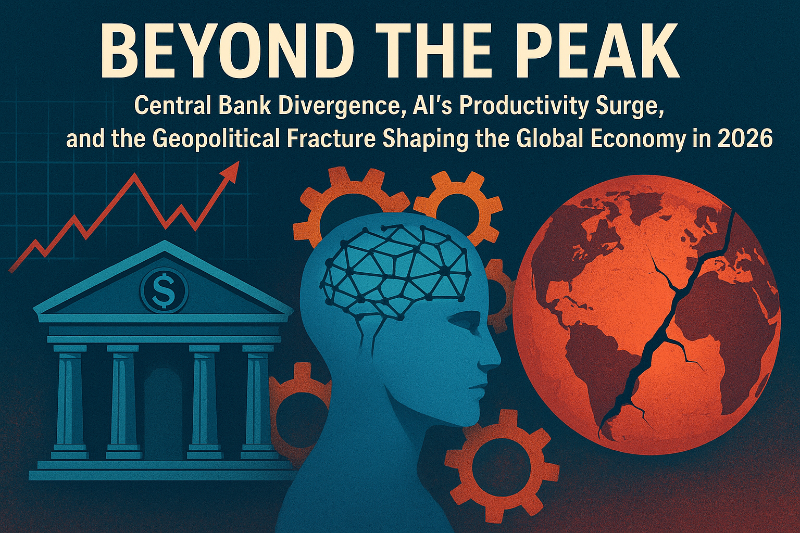
The Age of Divergence: Global Economic Re-Architecture (2025–2026)
---
1. Introduction: The Age of Divergence
The global economy presents a complex, paradoxical picture in late 2025. Risk assets exhibit remarkable resilience—creating an illusion of strength—while underlying growth fundamentals weaken.
- The S&P 500 has rebounded strongly since April, sitting ~6% above its February 2025 peak, reflecting optimism over technology and easing financial conditions. - However, the IMF reports a “dim” outlook for core economic growth, with momentum moderating across major economies. - The Conference Board’s LEI fell 0.5% in August 2025, signaling rising headwinds and delayed effects of monetary tightening.
The core tension—strong financial markets vs. weakening fundamentals—defines the 2026 landscape. Policymakers must reconcile this divergence amid persistent financial stability risks.
Three structural forces now define the new global order:
1. Cyclical Policy Exhaustion — Asynchronous central bank actions. 2. Structural Fragmentation — Trade wars and supply chain realignment. 3. Technological Augmentation — AI-driven productivity transformation.
---
2. Main Analysis: Four Forces Reshaping Global Dynamics
2.1. Force I: The End of Synchronized Tightening and the Dollar’s Grip
European Policy Pivot
- UK CPI inflation at 3.8% (Sept 2025); disinflationary trend suggests earlier BoE rate cuts. - Euro Area core inflation projected to fall from 2.4% (2025) to 1.9% (2026). - GDP growth to slow to 1.0%, requiring easing to avoid recession.US Monetary Conundrum
- US LEI down 0.5%, indicating slowing real activity. - The Fed faces a dilemma between asset market optimism and real-economy weakness.The Asynchronous Cycle
- ECB and BoE likely to ease before the Fed → USD strength persists. - This creates global spillovers, tightening EMDE financial conditions.The Mundell-Fleming Constraint
- Stronger USD → EMDEs raise rates defensively to prevent capital flight. - Results: higher debt costs, falling imports/exports, and amplified financial fragility.---
2.2. Force II: Geo-Economic Fragmentation and the Trade Churn
China’s Structural Weakness
- GDP growth slowed to 4.8% (Q3 2025). - Property investment down 13.9% YTD, first contraction since 2020. - Beijing’s hesitancy to fully stimulate the economy deepens the slowdown.Nearshoring and Regionalization
- Mexico exports: $313B (H1 2025, +4.3% YoY). - Trend reflects de-risking, not full decoupling — supply chains remain indirectly reliant on China.The Geopolitical Risk Premium (GPR)
- Geopolitical shocks (e.g., war, tariffs) increase commodity volatility, especially oil, wheat, and corn. - GPR acts as a persistent inflationary force, not merely an economic drag.---
2.3. Force III: The Looming Shadow of Global Debt and Fiscal Drag
Global Debt Scale
- Global debt > 235% of GDP (~$251 trillion). - Public debt = $99.2 trillion, a key IMF-identified risk.The Crowding Out Effect
- US borrowing: $1.9 trillion (2025). - Each deficit dollar displaces ~$0.33 of private investment. - Fiscal indiscipline erodes long-term growth and monetary policy credibility.NBFIs and Hidden Systemic Risk
- Nonbank Financial Institutions (NBFIs) pose growing liquidity risk. - If credit lines are fully drawn, 14% of US banks could face liquidity deficits. - IMF urges tighter oversight and stronger financial safety nets.---
2.4. Force IV: AI as a Structural Productivity Engine
The AI Productivity Shock
- Productivity growth in AI-exposed sectors up 27% since 2022 (4x faster than others). - AI transitions from incremental to transformational growth driver.The Skill Premium
- AI-skilled workers earn 56% higher wages (2024). - Skill-Biased Technical Change accelerates inequality and labor polarization.AI Investment Surge
- Global AI spending projected to exceed $2 trillion by 2026. - AI infrastructure (servers, semiconductors, cloud platforms) becoming a new asset class.> AI represents the Great Economic Divisor—a powerful driver of productivity but also inequality.
---
3. Future Implications and Strategic Mandates
3.1. Near-Term Outlook (6–12 Months)
| Region/Economy | Key Metric | 2025 | 2026 | Implication | |----------------|-------------|------|------|--------------| | Euro Area | Core Inflation | 2.4% | 1.9% | Early rate cuts likely | | Euro Area | GDP Growth | 1.2% | 1.0% | Policy easing needed | | UK | CPI Inflation | 3.8% | ↓ toward 2% | Inflation peaked | | US | LEI Change | -0.5% | Headwinds ahead | Growth slowdown risk |
- Global growth: 3.0% (2025) → 3.1% (2026). - Euro Area likely to pivot first; Fed delay strengthens USD. - China: heavy reliance on exports amid domestic weakness.
---
3.2. Risks and Opportunities
Key Risks
1. Fiscal Overreach — $1.9T US borrowing crowds out private investment (–33¢ per $). 2. Financial Amplification — NBFI-linked liquidity risk threatens systemic stability. 3. Geopolitical Stagflation — Supply shocks in oil or food could trigger inflationary slumps.Key Opportunities
1. AI Infrastructure Investment — $2T+ AI capital expenditure (2026) in semiconductors, data centers. 2. Regional Trade Winners — Mexico, Vietnam as nearshoring hubs. 3. European Bonds — Disinflation offers duration-driven capital gains potential.---
3.3. Actionable Insights for Stakeholders
Businesses (CFOs & Operations)
- Prioritize AI-driven automation and cost discipline. - Shift from legacy systems → AI-centric growth models. - Focus on ethical sourcing and circular economy initiatives.Investors (Portfolio Managers)
- Reduce exposure to highly leveraged NBFIs. - Diversify into infrastructure and nearshoring beneficiaries (Mexico, Vietnam). - Maintain FX hedging amid USD volatility.Policymakers
- Rebuild fiscal credibility—curb deficits to restore buffers. - Strengthen NBFI oversight and financial safety nets. - Regulate emerging assets (e.g., stablecoins) to prevent liquidity shocks.---
4. Conclusion: The Path to Re-Architecture
The global economy is not entering a cyclical downturn but a structural reconfiguration.
- Monetary Split: Eurozone eases first; US lags → sustained USD strength. - Trade Realignment: China’s property slump (–13.9%) contrasts with Mexico’s export boom ($313B H1 2025). - Debt Overhang: $251T debt caps long-term potential. - AI Shock: Quadrupled productivity growth, 56% wage premium → unequal prosperity.
> The defining race of 2026 will be between AI-driven productivity gains and the drag from debt, trade barriers, and shadow leverage.
Strategic Imperative:
Adopt technological augmentation and financial de-risking simultaneously. Survival in the new economic order depends on strategic agility, discipline, and adaptation to deep structural shifts.---
Table 2: Key Structural Forces Shaping the Global Economy
| Economic Force | Key Data Point (2025) | Quantitative Implication | Context | |----------------|------------------------|--------------------------|----------| | China Domestic Demand | Property Investment –13.9% YTD | GDP drag to 4.8%; domestic weakness | Unsustainable export reliance | | Technology Augmentation | AI Productivity ×4 in exposed sectors | Offsets global stagnation | Skill-biased technical change | | Sovereign Debt Risk | Global Debt >235% of GDP ($251T) | Fiscal drag and crowding out | Fiscal policy undermines monetary credibility | | Geo-Economic Fragmentation | Mexico Exports $313B (H1 2025) | Nearshoring momentum | De-risking supply chains | | Labor Market Divergence | AI Wage Premium +56% | Inequality surge | Technological polarization |
---