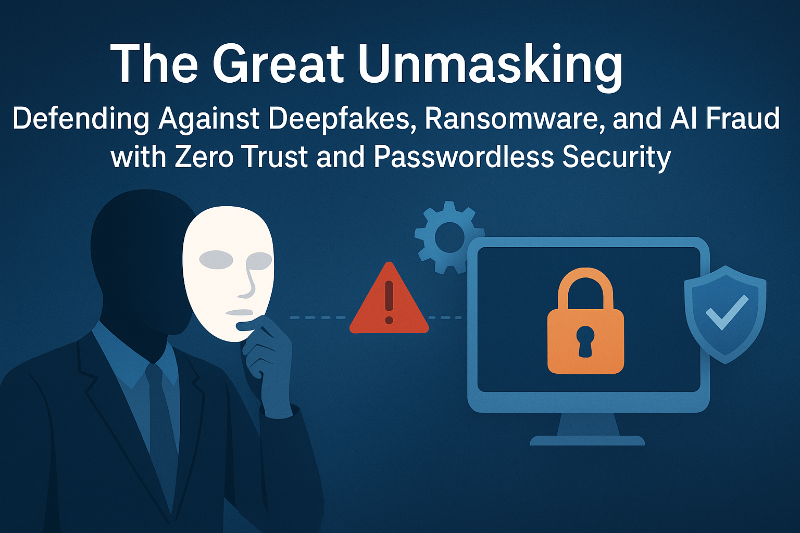
The Cybersecurity Imperative 2025: From Identity Crisis to Zero Trust Resilience
1. Threat Landscape Overview
The Identity Crisis: Phishing and AI Acceleration
The modern cybersecurity landscape is shaped by relentless threat acceleration and weaponized deception. Human error and identity compromise remain the top vulnerabilities—phishing scams account for 80–95% of all human-related breaches. With AI-driven phishing growing by over 1,265%, attackers can now create highly personalized, convincing deception campaigns. Deepfake files are projected to surge from 500,000 in 2023 to 8 million by 2025, resulting in a 3,000% rise in fraud attempts. Humans detect deepfakes accurately only 24.5% of the time—making technical defenses like passwordless MFA (Passkeys) essential.The Evolution of Extortion: Double and Triple Ransomware
Ransomware represents 35% of all cyberattacks, costing organizations over $12.4 million in 2024. Attackers now employ Double Extortion (data theft + encryption) and Triple Extortion (adding DDoS and third-party pressure). This means recovery is not just about decryption—it’s about preventing data leakage and maintaining regulatory and reputational resilience.The Dissolution of the Traditional Perimeter
The perimeter-based security model is obsolete. With remote work, cloud, and SaaS, attackers simply log in using stolen credentials rather than “breaking in.” This shift demands identity-centric, dynamic verification—the foundation for Zero Trust Architecture (ZTA).---
2. Core Security Strategies: The Modern Defense Toolkit
2.1 Strategy A: Phishing-Proof Identity — MFA and Passkeys
- MFA blocks 99.2% of account compromise attacks. - Move away from SMS-based MFA to FIDO2/Passkey authentication. - Microsoft will enforce mandatory MFA for Azure sign-ins by Oct 2025.Implementation Steps: 1. Enforce MFA on all systems (email, cloud, CRM, banking). 2. Adopt FIDO2 keys (e.g., YubiKey) or Passkeys. 3. Address employee resistance with awareness and flexible solutions.
---
2.2 Strategy B: Centralized Credential Management
Password managers prevent reuse and improve oversight. Bitwarden and Proton Pass are strong personal choices; 1Password and Zoho Vault serve business needs.| Security Layer | Personal | SMB/Business | |----------------|-----------|--------------| | Identity Mgmt | Proton Pass, Bitwarden | 1Password, Zoho Vault | | Endpoint Protection | Built-in Defender | Defender for Endpoint, CrowdStrike Falcon | | Data Protection | Cloud Backup (Proton Drive) | Immutable Backups (3-2-1 Rule) |
---
2.3 Strategy C: The EDR Imperative
Traditional antivirus is outdated. Endpoint Detection and Response (EDR) provides continuous, behavioral monitoring—detecting zero-day and fileless threats.Recommended Tools: - Microsoft Defender for Endpoint (integrated solution) - CrowdStrike Falcon / SentinelOne (behavioral focus) - Huntress MDR (for SMBs without security teams)
---
2.4 Strategy D: Data Encryption and Immutable Backups
- Use Full Disk Encryption (FDE) — BitLocker (Windows), FileVault (macOS). - Follow the 3-2-1 Rule: 3 copies, 2 media types, 1 offsite immutable copy. - Immutable backups ensure ransomware cannot destroy recovery data.---
3. Advanced Protection Methods: Shifting the Paradigm
3.1 Zero Trust Architecture (ZTA)
Zero Trust = Never Trust, Always Verify.| Principle | Description | Action | |------------|--------------|--------| | Never Trust, Always Verify | No implicit trust; verify continuously | Use Passkeys + adaptive MFA | | Least Privilege Access | Minimum access per role | Use Just-In-Time (JIT) and JEA | | Micro-segmentation | Isolate assets and networks | Deploy ZTNA tools | | Assume Breach | Prepare for compromise | Use XDR and continuous monitoring |
ZTA connects identity protection (MFA, Passkeys) with visibility tools (EDR/XDR).
---
3.2 Extended Detection and Response (XDR)
XDR unifies telemetry across endpoint, network, cloud, and identity layers. This integration helps detect lateral movement and exfiltration attempts that standalone EDR systems miss.---
3.3 Emerging Privacy & Authentication Technologies
- Behavioral Biometrics: Continuous authentication via keystroke/movement patterns. - Privacy-Enhancing Technologies (PETs): Enable secure data use and AI model training while preserving confidentiality.---
4. Implementation Guide: Path to Resilience
4.1 Budget Allocation
- Small businesses should allocate 4–10% of IT budget to cybersecurity. - Direct 15–30% of that toward MFA, EDR/XDR, and backup resilience.4.2 Action Plan
| Priority | Action | Timeline | Justification | |-----------|---------|-----------|----------------| | P1 | Enforce phishing-resistant MFA | 1–2 weeks | Blocks 99% of attacks | | P2 | Deploy EDR solution | 4 weeks | Detects advanced threats | | P3 | Implement immutable backups | Ongoing | Prevents extortion/data loss | | P4 | Employee training (deepfakes, phishing) | Quarterly | Reduces human error |
---
4.3 Addressing Implementation Challenges
Common pitfalls include: - Applying MFA to limited accounts only - Underestimating user resistance - Neglecting Zero Trust enforcementMitigate these by: - Applying MFA universally - Selecting user-friendly security tools - Communicating risk vs inconvenience clearly
---
5. Conclusion
The cybersecurity landscape of 2025 is defined by AI-powered deception and multi-stage extortion. The path forward requires: - Phishing-resistant identity (Passkeys/FIDO2) - Zero Trust Architecture for continuous verification - EDR/XDR deployment for unified threat visibility - Immutable data backups to counter ransomware extortion
Cybersecurity is not a product—it’s a continuous organizational strategy. By executing these P1 priorities, organizations can evolve from reactive defense to architectural resilience, ensuring survival against the accelerating threat ecosystem.