I. Mental Health Introduction: The Global Landscape of Worry
The Scale of the Global Crisis and Mental Health Urgency
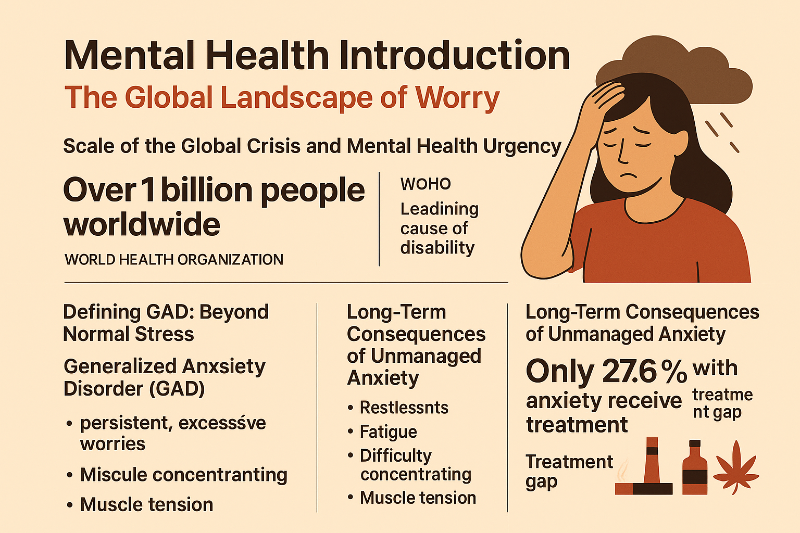
Mental health conditions represent one of the most pressing global public health challenges of the modern era. Current data from the World Health Organization (WHO) reveal a staggering statistic: over one billion people worldwide are currently living with a mental disorder, yet the majority remain underserved by existing healthcare systems. Mental disorders are a leading cause of disability globally, inflicting immense human and economic tolls on communities and countries.
Anxiety disorders stand out as the most common class of mental disorder worldwide. In 2021, approximately 13.9% of the world's population experienced a mental disorder, with anxiety and depressive disorders collectively ranking as the most frequent causes of health loss. The United States mirrors this high prevalence, with an estimated 31.1% of adults expected to experience an anxiety disorder at some point in their lifetime. These conditions are the second biggest reason for long-term disability, contributing significantly to loss of healthy life years and rising healthcare costs.
Despite the profound impact and high prevalence, there is a massive treatment gap — only about 1 in 4 people (27.6%) with anxiety receive any treatment, even though effective interventions exist. This deficit points to global shortages in resources, workforce, and quality of care. Hence, scalable, evidence-based strategies—particularly those leveraging technology and integrated care—are critical public health priorities.
---
Defining GAD: Beyond Normal Stress
Generalized Anxiety Disorder (GAD) is frequently misunderstood, often confused with situational stress. Stress is an emotional and physical response to identifiable external triggers such as deadlines or conflict. Anxiety, by contrast, is characterized by persistent, excessive worries that persist even when the original stressor disappears.
GAD involves ongoing, uncontrollable worry that interferes with daily life and includes physical symptoms such as:
- Restlessness - Fatigue - Difficulty concentrating - Muscle tension - Insomnia
For diagnosis, the anxiety must persist for months and significantly impair functioning.
---
The Long-Term Consequences of Unmanaged Anxiety
Untreated anxiety disorders frequently lead to co-occurring conditions — nearly half of those diagnosed with major depression also have an anxiety disorder. Anxiety can also co-occur with ADHD, eating disorders, IBS, chronic pain, and sleep disorders.
Unmanaged anxiety often results in unhealthy coping mechanisms such as:
- Tobacco or alcohol use - Cannabis use - Overuse of sedatives or sleep medication
These behaviors can worsen the disorder and lead to dependency. The need for non-addictive, sustainable coping mechanisms is urgent.
---
II. Scientific Foundation: Understanding the Anxious Circuitry
The Neurobiological Basis of Sustained Worry
GAD has identifiable neurobiological signatures, notably the dysregulation between:
- Amygdala (fear/threat detection) - Prefrontal Cortex (PFC) (emotional regulation)
In GAD, the amygdala shows hyperactivity, while the PFC demonstrates reduced connectivity, resulting in a deficit of top-down control. This leads to a state of sustained threat, where individuals remain psychologically and physiologically hypervigilant.
Key Neurotransmitter Systems in GAD
- GABA: Reduced inhibitory signaling → excessive neuronal excitability. - Serotonin/Norepinephrine: Dysregulated mood and arousal; targeted by SSRIs/SNRIs.---
The Interplay of Genetics and Environment
GAD’s origins lie in the interplay of genetic vulnerability (30–50%) and environmental stressors.
- Genetic variants (e.g., 5-HTTLPR) heighten amygdala sensitivity. - Environmental stressors (childhood trauma, chronic stress) dysregulate the HPA axis, reinforcing chronic anxiety.
Over time, genetic factors influence the persistence of anxiety, while environmental factors often trigger its onset.
---
Table 1: Biopsychosocial Factors Influencing Anxiety Development
| Factor Category | Mechanism/Component | Clinical Insight | Source ID | |-----------------|--------------------|------------------|------------| | Biological (Brain) | PFC-Amygdala Dysregulation | Reduced top-down control | 13,12 | | Biological (Chemical) | Neurotransmitter Imbalance | Dysfunction in GABA, Serotonin, Norepinephrine | 15 | | Genetic | Heritability/Epigenetics | 30%-50% genetic contribution | 13 | | Environmental | Chronic Stress/Trauma | HPA axis dysregulation | 17 |
---
III. Evidence-Based Strategies: Mastering Worry and Building Resilience
Effective management of GAD relies on multimodal, evidence-based approaches:
---
Strategy 1: Cognitive Behavioral Therapy (CBT)
CBT is the gold-standard psychological intervention for GAD, usually delivered over 12–16 weeks. It targets the feedback loop between dysfunctional thoughts, distress, and unproductive behavior.
Mechanism: Enhances PFC regulation, reducing amygdala overactivation.
The 4 Steps of Cognitive Restructuring (CR):
1. Identify the situation and automatic thought (ANT). 2. Evaluate the evidence for and against it. 3. Develop a realistic, balanced alternative thought. 4. Test it through real-world behavioral experimentation.
---
Strategy 2: Mindfulness & Acceptance-Based Therapies (MBSR / ACT)
MBSR focuses on non-judgmental awareness—observing anxiety without reacting. ACT emphasizes psychological flexibility—accepting distressing thoughts while pursuing core life values.
Key practice: Values Clarification, shifting focus from control to meaningful action.
---
Strategy 3: Aerobic Exercise
Regular aerobic exercise (3–5x per week) reduces anxiety through both biological and psychological pathways.
- Increases BDNF, enhancing neuroplasticity and stress resilience. - Induces a mindful flow state, improving mood and self-efficacy. Both low- and high-intensity activities are beneficial.
---
Strategy 4: Digital Therapeutics and AI (2025)
Digital Therapeutics (DTx) deliver validated CBT or mindfulness interventions via software (e.g., DaylightRx, FDA-cleared for GAD).
AI-powered chatbots like Therabot provide 24/7 support and demonstrated 31% symptom reduction in clinical trials.
Ethical Considerations:
- AI must augment, not replace human clinicians. - Safeguards for data privacy, bias, and informed consent are essential.---
Table 2: Comparing Evidence-Based Anxiety Interventions
| Intervention | Mechanism | Typical Duration | Efficacy | Source ID | |---------------|------------|------------------|-----------|------------| | CBT | Cognitive restructuring | 12–16 sessions | First-line, long-term effective | 21 | | MBSR/ACT | Acceptance & mindfulness | 8 weeks | Comparable to CBT for acute anxiety | 28 | | Aerobic Exercise | Neuroplasticity (BDNF) | Ongoing | Strong anxiolytic effects | 32 | | Digital Therapeutics | Software-delivered CBT | 6–12 weeks | FDA-cleared, scalable | 36 |
---
IV. Professional Support & Resources: Navigating the Care Pathway
When to Seek Professional Help
Seek professional help when:
- Worry becomes disproportionate or disabling. - Daily functioning, work, or relationships suffer. - Physical symptoms persist (e.g., chronic insomnia, muscle tension). - Coping involves substance use or avoidance.
---
Comprehensive Treatment Modalities
- Psychotherapy: CBT and ACT remain first-line interventions. - Pharmacotherapy: SSRIs and SNRIs are first-line medications. - Continue for 6–12 months post-response to prevent relapse. - Benzodiazepines: not first-line due to dependency risk.
---
Addressing Systemic Barriers to Care
Table 3: Systemic Barriers and Mitigation Strategies
| Barrier Type | Challenge | Impact | Mitigation Strategy | Source | |---------------|-----------|--------|----------------------|--------| | Societal | Stigma & Discrimination | 84% cite stigma as barrier | Awareness campaigns, NAMI support | 54 | | Financial | Cost & Insurance Gaps | 52% avoid treatment due to cost | Parity laws, better employer coverage | 54 | | Structural | Workforce Shortage | Only 27.6% receive treatment | Telehealth, DTx integration | 40 |
---
Essential Crisis & Support Resources
U.S. Emergency Support:
- 988 Suicide & Crisis Lifeline — 24/7 free, confidential help - Crisis Text Line — Text HOME to 741741
Non-Crisis Support:
- NAMI Helpline: 1-800-950-NAMI (6264) - SAMHSA Helpline: 1-800-662-HELP (4357)
---
Health-Focused Ad Placement Opportunities
- Digital Therapeutics (DTx): Promote FDA-cleared GAD apps (e.g., DaylightRx). - Affiliate Marketing: Partner with wellness brands aligned with clinical advice. - Targeted Search Ads: Focus on terms like “evidence-based therapy near me.”
---
V. Conclusion: Hope, Resilience, and the Future of Personalized Care
Generalized Anxiety Disorder is highly treatable. Recovery hinges on active skill development—strategies like CBT and aerobic exercise build neuroplastic resilience.
The future of mental health is precision care: - AI models predict long-term GAD recovery with 72% accuracy, guiding clinicians toward optimized interventions. - The shift from trial-and-error to personalized, predictive treatment is underway.
Investing in mental health—whether through therapy, technology, or lifestyle change—is an investment in long-term well-being and productivity. Seeking support is not weakness—it is the first step toward healing and resilience.