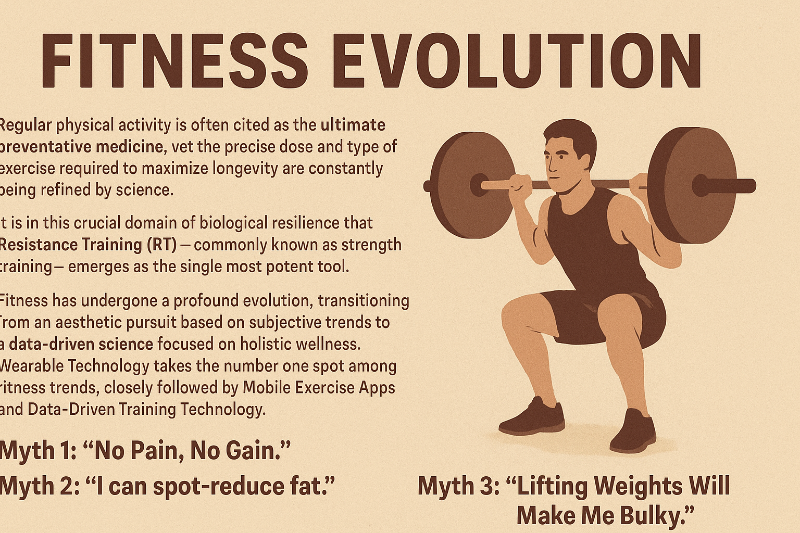
The Fitness Evolution: How Resistance Training Redefines Longevity and Healthspan
1. Fitness Evolution Introduction
Regular physical activity is often cited as the ultimate preventative medicine, yet the precise dose and type of exercise required to maximize longevity are constantly being refined by science. The evidence is clear and compelling: individuals who engage in sufficient physical activity dramatically reduce their risk of death.
Specifically, adults who perform two to four times the minimum recommended moderate physical activity—equating to approximately 300 to 599 minutes per week—achieve a 26% to 31% lower all-cause mortality risk. This foundational statistic underscores the immense, life-altering benefits of moving the body intentionally.
However, the modern pursuit of health has moved beyond simply extending lifespan (how long a person lives) to strategically maximizing healthspan (the years lived free of disease and disability). It is in this crucial domain of biological resilience that Resistance Training (RT)—commonly known as strength training—emerges as the single most potent tool.
Recent scientific literature provides molecular proof of its power: consistent resistance training, even as little as 90 minutes per week, has been shown to effectively reverse biological aging by nearly four years. This reframes RT not as a niche pursuit for athletes or bodybuilders, but as essential anti-aging medicine accessible to everyone.
---
The New Wellness Paradigm: Data and Demand
Fitness has undergone a profound evolution, transitioning from an aesthetic pursuit based on subjective trends to a data-driven science focused on holistic wellness. This shift reflects a comprehensive consumer approach to health, driven by a global wellness economy valued at $6.3 trillion, with physical activity contributing $1 trillion of that figure.
Consumers are now seeking how mental and physical health can support one another, driving demand for validated, high-value strategies.
2025 Fitness Industry Trends
- Wearable Technology – Ranks #1 among fitness trends - Mobile Exercise Apps – Widespread adoption and personalization - Data-Driven Training Tech – Precise tracking of sleep, recovery, and movement velocityThe collective desire is for control and clarity in one’s health journey—moving away from generalized plans toward personalized, data-informed approaches. Effective implementation of RT must therefore integrate these modern data sources and adapt to individual physiological responses.
---
Debunking the High-Cost and High-Pain Myths
Widespread adoption of RT is often blocked by common myths. Let’s debunk them:
Myth 1: “No Pain, No Gain.”
Pain is not a measure of success—it’s often a warning sign. Overtraining leads to fatigue and injury. ✅ Focus on consistency and quality: 3–5 intense, well-structured workouts per week are enough when paired with proper recovery and sleep.Myth 2: “I Can Spot-Reduce Fat.”
Fat loss cannot be localized to one area. Core exercises strengthen muscles but don’t directly reduce belly fat. ✅ Combine strength + cardio and maintain a balanced diet for systemic fat reduction.Myth 3: “Lifting Weights Will Make Me Bulky.”
Due to hormonal differences, large muscle bulk is very difficult to achieve unintentionally. ✅ RT builds dense, functional muscle, improves posture, strengthens bones, and enhances longevity.---
2. Scientific Foundation: The Biological Engine
Resistance Training as Molecular Geroscience
Aging involves oxidative stress, chronic inflammation, and protein-folding issues. RT counteracts these by: - Modulating inflammatory response - Balancing oxidative stress - Increasing expression of Klotho and HSP60, proteins linked to longevity and cellular protection
Even skin benefits from RT—research shows it improves elasticity, reduces inflammation, and enhances dermal structure.
---
The Anabolic Stimulus: Muscle Protein Dynamics
Skeletal muscle (~40% of body weight) is critical for energy metabolism. RT activates mTORC1 and ribosomal biogenesis, driving new muscle protein synthesis.
This combats sarcopenia, the age-related decline in muscle mass and strength—a leading cause of frailty and dependence.
💡 Adults should engage in muscle-strengthening exercises at least twice weekly to prevent this decline.
---
Metabolic and Cardiovascular Synergy
Metabolism and RMR
Muscle tissue significantly increases Resting Metabolic Rate (RMR), which accounts for 60–70% of total daily energy use. Losing muscle through dieting lowers RMR and encourages rebound weight gain—RT prevents this by maintaining or increasing muscle mass.Cardiovascular Health
RT: - Reduces blood pressure - Improves insulin sensitivity and lipid profilesCombining RT + cardio amplifies benefits—reducing all-cause mortality risk by up to 40%.
---
| System | Mechanism / Biomarker | Longevity Benefit | |--------|------------------------|-------------------| | Cellular Health | Modulates oxidative stress, ↑ Klotho & HSP60 | Slows aging, improves skin health | | Metabolism | ↑ Lean muscle, ↑ insulin sensitivity | Higher RMR, reduced diabetes risk | | Cardiovascular | ↓ BP, ↑ endothelial function | Lower CVD risk | | Musculoskeletal | ↑ bone density, ↑ muscle protein synthesis | Prevents sarcopenia, osteoporosis |
---
3. Practical Application: Routines for Every Level
Compound Movements – The Efficiency Engine
The six foundational compound movements: 1. Squat (Anterior Chain) 2. Deadlift / Hinge (Posterior Chain) 3. Horizontal Push (Bench Press / Push-Up) 4. Vertical Push (Overhead Press) 5. Horizontal Pull (Row) 6. Vertical Pull (Pull-Up / Lat Pulldown)These exercises maximize time efficiency, engage multiple muscle groups, and build functional strength.
---
Adaptive Strategies: No Gym, No Problem
Use household items for home workouts: - Weights: Water/sand-filled jugs, backpacks with books - Resistance: Towels or shirts for isometric tension - Stability: Chairs or tables for step-ups, rows
Bodyweight Substitutions
- Squats → Step-Ups / Reverse Lunges - Deadlifts → Glute Bridges / Hip Thrusts - Rows → Table Rows---
Training by Level
| Level | Frequency | Split | Focus | |-------|------------|-------|--------| | Novice | 2–3 days/week | Full body | Form mastery & endurance | | Intermediate | 3–4 days/week | Upper/Lower | Progressive overload | | Advanced | 4–5 days/week | Custom / PPL | Intensity manipulation (RPE, TUT, density) |
---
Example: 2-Day Full Body Routine
Day 1 - Squat Variation – 3×12 - Incline Push-Up – 3×12 - Table Row – 3×12 - Plank – 3×60 sec - Bicep Curl – 3×15
Day 2 - Reverse Lunge – 3×10 each leg - Glute Bridge – 3×15 - Overhead Press – 3×12 - Single-Leg RDL – 3×10 each leg - Triceps Pushdown – 3×15
---
The Engine of Progress: Progressive Overload (PO)
Progress = continuous challenge. Methods: 1. Increase weight 2. Add reps or sets 3. Reduce rest time 4. Slow tempo (↑ Time Under Tension) 5. Add training frequency 6. Improve range of motion 7. Increase complexity (unilateral work) 8. Combine exercises (supersets, tri-sets)
---
Modern Intensity Management: RPE (Rate of Perceived Exertion)
| RPE | Reps in Reserve | Description | |-----|------------------|-------------| | 10 | 0 | Max effort | | 9 | 1 | Very hard | | 8 | 2 | Hard (ideal for hypertrophy) | | 6–7 | 3–5 | Moderate intensity | | ≤5 | ≥6 | Light / recovery work |
RPE personalizes intensity based on daily energy and recovery, avoiding under- or overtraining.
---
4. Integration & Sustainability: Making Strength a Habit
Consistency Through Habit Stacking
Use the formula: > “After I [current habit], I will [new habit].”
Examples: - “After I pour my morning coffee, I’ll do 15 squats.” - “After work, I’ll hold a 60-second plank.”
Small, consistent actions automate behavior and eliminate reliance on motivation.
---
Injury Prevention: Form, Warm-Up, and Rest
- Master technique before increasing load - Prioritize dynamic warm-ups: walking lunges, leg swings, arm circles - Maintain proper posture; avoid ego lifting---
The Critical Role of Recovery Nutrition
Consume protein + carbs within 30 minutes post-workout (3:1 or 4:1 ratio). Example: whey protein shake + banana. This speeds recovery and boosts adaptation.---
Seamless Integration Into Daily Life
- Schedule workouts like meetings - Take stairs whenever possible - Mini-workouts: 10 squats or push-ups every 30 minutes - Walk and talk during phone callsSmall, repeated activity adds up and sustains energy levels throughout the day.
---
5. Conclusion: Commit to the Compound Life
Resistance Training is the most powerful non-pharmacological intervention for extending healthspan. It enhances: - Metabolic health - Muscle and bone strength - Cardiovascular resilience - Cognitive and functional independence
> “Start simple, prioritize form, and commit to one RT habit this week.”
Consistency—not intensity—is the true driver of transformation. Strength is not just built in the gym; it’s built in your habits.
---
⚠️ Health Disclaimer
The information provided here is for educational purposes only and not a substitute for medical advice. Always consult a qualified healthcare professional before beginning any new exercise program, especially if you have existing medical conditions or are new to strength training.