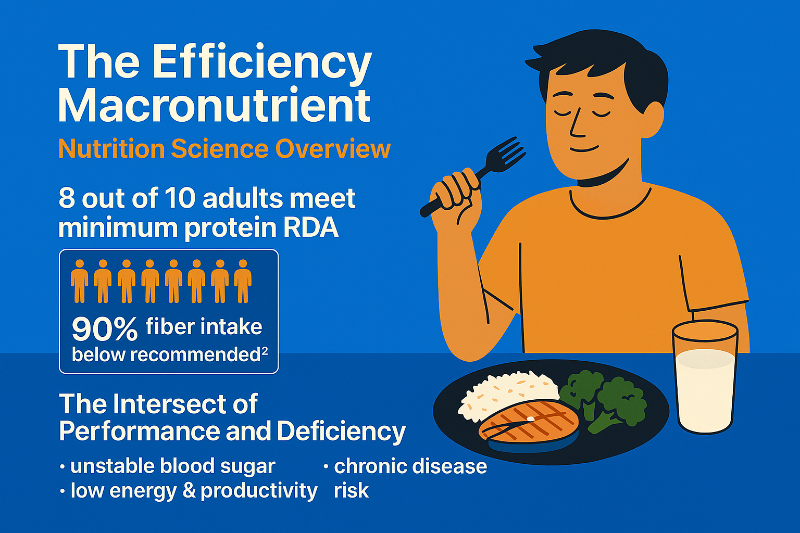
I. The Efficiency Macronutrient: Nutrition Science Overview
The modern professional faces a constant barrage of deadlines and decisions, where sustained mental clarity and physical energy are paramount. Nutrition science highlights that the typical consumption pattern—heavy on refined carbohydrates and light on foundational nutrients—is counterproductive to performance.
While current dietary discourse often focuses relentlessly on high protein intake, a surprising reality exists: approximately 8 out of 10 adults in the United States already meet the minimum Recommended Dietary Allowance (RDA) for protein.¹
However, for the high-performing professional seeking optimal function and body composition, the problem is not deficiency but insufficiency for performance goals, coupled with a deep, silent deficit in other vital areas.
For instance, data indicates that more than 90% of the population fails to meet the recommended daily intake for dietary fiber.²
This creates a critical intersection: inadequate protein for peak performance, combined with insufficient fiber, leads to unstable blood sugar, energy crashes, poor gut health, and consequently, diminished productivity and chronic disease risk.³
Proper nutrition is fundamental to achieving health, supporting lifelong development, and mitigating the risk of non-communicable diseases (NCDs) like Type 2 diabetes and cardiovascular illness.⁵ These conditions are often amplified by the chronic stress and inconsistent eating habits endemic to busy, modern lifestyles.⁴
Protein emerges as the essential macronutrient for stability, playing a central role in promoting long-term satiety, maintaining stable energy levels, and preserving metabolically active tissue, specifically muscle mass.⁶
Therefore, the current focus is not merely on increasing protein quantity but on optimizing intake beyond basic survival to achieve peak professional and physical performance — centering on a High-Efficiency Protein strategy.
---
Debunking the Myth of the Minimum
A primary misconception for many aspiring to better health is that the protein RDA is the target goal.
The RDA for protein (0.8g/kg body weight) is designed to meet minimum needs for 97.5% of sedentary individuals to prevent deficiency — not to optimize function.¹
For those who are highly active, training rigorously, or seeking high-quality weight loss (maximizing fat loss while preserving muscle), protein needs rise substantially — typically 1.0–1.7g/kg/day, and even higher in older adults to combat sarcopenia.¹⁰
Thus, the strategic professional should target this higher, performance-oriented range.
---
Protein as a Buffer Against Stress
High-stress lifestyles elevate cortisol and counterregulatory hormones, destabilizing blood glucose and triggering energy crashes.¹³
Protein, with its low glycemic index, buffers glucose release, stabilizing energy throughout the day.¹⁵
Moreover, prioritizing protein naturally encourages more nutrient-dense, fiber-rich foods — such as legumes, beans, and whole grains — creating compounded benefits for gut health and sustained energy.¹⁷
---
II. Scientific Foundation: The Science of Protein Efficiency
The Metabolism of Muscle and Recovery
Proteins are composed of 20 amino acids, nine of which are essential.⁸ These amino acids support not only muscle but also immunity, energy production, and tissue repair.²⁰
Muscle Protein Synthesis (MPS), primarily driven by leucine, is the process that repairs and builds tissue.²²
Animal proteins generally have higher DIAAS scores and leucine content, leading to a stronger anabolic response.²² However, strategic plant-based options (e.g., soy, potato protein) can still provide comparable anabolic effects.¹¹
---
Optimal Dosing and Distribution
For active adults, 1.2–1.7g/kg/day is optimal, rising to 1.6–2.4g/kg/day for those in a caloric deficit or aiming for muscle preservation.⁹
Protein Distribution:
Research supports spreading protein evenly — about 20–40g per meal every 3–4 hours — to maintain consistent MPS stimulation.²⁸
Recent 2024 data suggests that consuming a larger bolus (up to 100g) post-workout can sustain amino acid availability for several hours — useful for busy professionals with irregular eating schedules.³⁰
---
Benefits and Required Precautions
Physiological Benefits: - Enhanced Satiety — reduces cravings and stabilizes appetite.⁶ - Glycemic Stability — reduces energy crashes by moderating blood sugar.¹⁶
Precautions: - Intake exceeding 2g/kg can strain kidneys in individuals with pre-existing renal disease.³¹ - Diets high in saturated fat from red meats elevate cardiovascular risk.³¹
Mitigation: Choose lean meats, fish, dairy, eggs, and legumes for balanced intake.
---
Table 1: Optimal Daily Protein Intake Ranges
| Activity Level | Protein Requirement (g/kg) | Example (79kg Adult) | Goal Rationale | |-----------------|----------------------------|----------------------|----------------| | Sedentary | 0.8 | ~63g | Basic maintenance | | Light Activity | 1.0–1.2 | 79–95g | Healthy aging | | Active/Training | 1.2–1.7 | 95–134g | Repair & performance | | Caloric Deficit | 1.6–2.4 | 126–190g | Preserve muscle & burn fat |
---
III. Operationalizing Protein Intake: Practical Strategies for the Non-Stop Life
Designing the High-Protein System
The foundation is the 20–40g Rule: include a meaningful protein dose at every eating opportunity (3–5 times daily).³⁵
Front-Loading Protein
Start the day with 25–35g at breakfast to boost satiety and reduce mental fatigue from dietary decision-making later in the day.³⁶ ³⁸---
Time-Saving Meal Prep and Batch Strategies
- Batch-cook proteins (chicken, turkey) for quick meals.³⁹ - Hard-boiled eggs for portable snacks.³⁶ - Greek yogurt or cottage cheese with nuts or fruit for convenience.⁴²
---
Table 2: Quick 20–30g Protein Meal Ideas (The 5-Minute Fix)
| Meal/Snack | Protein (g) | Prep Time | Use Case | |-------------|-------------|------------|----------| | Greek Yogurt Bowl | 20–25 | 2 min | Desk breakfast | | Overnight Oats + Whey | 25–30 | 5 min | Morning fuel | | Ready-to-Drink Shake | 30–42 | 0 min | Travel/emergency | | Tuna & Bean Salad | 25–30 | 10 min | No-cook lunch | | Cottage Cheese & Crackers | 20 | 1 min | Snack |
---
Protein on a Budget
Affordable, high-efficiency sources: - Dairy: Cottage cheese, eggs, Greek yogurt.⁴³ - Legumes: Lentils, beans, chickpeas.⁴² - Canned/Frozen: Tuna, salmon, ground turkey.⁴³
These staples deliver protein and fiber, supporting satiety and nutrient density.
---
Navigating Eating Out and Travel
- Pre-Plan: Check menus for lean protein options.³⁷ - Protein-First Ordering: Prioritize grilled fish, chicken, tofu; request sauces on the side.⁵² - Portable Safety Net: Carry protein bars, jerky, or powder packs.⁴⁴
---
Overcoming Psychological Barriers
- Avoid Overwhelm: Change one habit at a time (e.g., start with high-protein breakfast).⁵⁵ - Reject Perfectionism: Consistency matters more than strict precision.⁵⁷ - Flexible Tracking: Log essential proteins ahead of time to avoid decision fatigue.⁵⁵
---
IV. Holistic Health Integration: Protein as a Wellness Anchor
Protein and Exercise Synergy
- Strength Training: 1.2–1.7g/kg for hypertrophy.¹² - Endurance Training: 1.6–2.0g/kg for recovery.⁵⁹
Consume protein around workouts — the “window” now spans several hours pre/post-training.²⁶
---
Mental Clarity and Stress Management
High-protein, fiber-rich diets prevent blood sugar volatility and stabilize mood, focus, and energy.¹³ ¹⁶
Amino acids fuel neurotransmitter synthesis, directly supporting cognitive performance.²¹
---
Optimizing Overnight Recovery and Sleep
Consume 40–48g of casein (slow-digesting protein) ~30 minutes before bed.⁶¹ This supports overnight MPS without affecting sleep quality.⁶³
---
Sustainable Long-Term Strategies: Habit Stacking
Integrate protein habits into existing routines:⁶⁴ - Add collagen/whey to morning coffee.⁵⁴ - Pair evening routine with a protein snack.⁶⁴ - Add protein shake to gym bag prep.⁵³
Small, automated actions reduce decision fatigue and improve adherence.
---
V. Conclusion: Making Protein a Sustainable Priority
High performance and longevity rely on strategic, evidence-based nutrition, not diet fads.
Key takeaways: - Daily Target: 1.2–1.7g/kg body weight (20–40g per meal). - Distribution: Even spread across meals for optimal MPS. - Sustainability: Structured flexibility through prep, convenience, and planning.
Core Implementation:
- Convenience: Use shakes, yogurt, and pre-cooked meals. - Affordability: Leverage eggs, lentils, and canned fish.⁴³ - Recovery: Add pre-sleep casein for muscle repair.⁶¹Start small. Focus on one key habit (e.g., high-protein breakfast). Over time, consistency builds results.⁵⁵
---
Crucial Health Advisory
This content is for educational purposes and based on current nutrition science.
Protein needs vary by age, sex, activity, and health. Individuals with kidney/liver conditions or using GLP-1 medications should consult a licensed physician or RDN before changing protein intake.³
---
By viewing each choice as an investment in energy and efficiency, professionals can make gradual, informed improvements that yield exponential returns in performance, resilience, and long-term health. The path to superior health is one of strategic refinement, not perfection.